Walk any jobsite and builders are investing heavily in flashing details, weather barriers and drainage planes. Anything to keep bulk water out. Yet the real budget-buster is often the water no one sees: indoor humidity that condenses on windows, seeps into drywall and quietly breeds callbacks.
Buyers are also savvier. They expect cleaner air, balanced humidity and steady comfort — especially as indoor air quality (IAQ) has moved from mechanical jargon to a front-and-center selling point. If specifications don't address fresh-air strategy, another builder's will.
Energy recovery ventilators (ERVs) solve that gap. By exchanging stale indoor air with filtered outdoor air, while transferring heat and moisture between airstreams, ERVs turn tightly sealed homes into healthy, stable living spaces that satisfy code and comfort.
In this article, we'll explain all there is to know about ERVs and what makes them such a value-add for builders.
What are ERVs and how do they work?
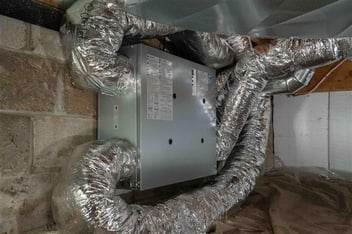
An ERV is a balanced ventilation unit with two fans and a high-efficiency core. One fan exhausts stale indoor air, the other brings in filtered outdoor air. Inside the core, heat and moisture transfer between the airstreams so indoor temperature and humidity stay steady with minimal energy penalty.
"It's continuous ventilation," explains Ken Nelson, building and IAQ expert at Panasonic Eco Systems North America. "If you have a high moisture load, it can help reduce that load. If it's low, it adds moisture back in."
Consider what this means on-site:
- Stabilizes humidity to prevent window condensation and paint touch-ups
- Reduces mold risk and soggy drywall that leads to warranty claims
- Helps flooring and trim resist warping in shoulder seasons
- Keeps HVAC equipment operating in its ideal range for efficiency
Moisture management is money management. "If a builder has to go back because there's water on a window, that's a cost. If we can eliminate that, that's cash money," Nelson says. That means fewer callbacks, happier homeowners and a healthier bottom line for every project.

Understanding ERVs and why builders overlook them
A growing number of production homes now deliver blower-door numbers their predecessors couldn't touch, yet occupant surveys still flag rooms that feel muggy in summer and dry in winter. This is the widening gap between "building tight" and "living right."
"A builder can build a great envelope — super tight, keeps heat in or out – but he can't manage moisture. That's an occupant variable. The ERV levels that out," explains Ken Nelson.
Still, ERVs remain underutilized. Why?
- Perceived cost without a clear ROI
- Confusion about ERV moisture handling in mixed or humid climates
- Habitual reliance on exhaust-only fans even as codes shift to balanced ventilation
- Limited awareness that IAQ complaints can depress buyer satisfaction and HERS scores
Despite this, ERVs outperform exhaust-only ventilation on the metrics that matter to builders, buyers and energy raters.
Dispelling myths: clearing the air about ERVs
Misconceptions can stop even the most forward-thinking builders from specifying an ERV. The biggest myth? Introducing outdoor air is a recipe for indoor humidity headaches, especially in muggy climates.
"Outdoor air at 83% humidity entered the house at 59%. We rejected about 24% of that moisture before it even came in." — Ken Nelson
Let's take a moment to dispel a few of these common ERV myths:
- Myth: ERVs add humidity in hot, wet regions
- Fact: The core, a component that transfers heat and moisture, rejects excess moisture so that supply air arrives drier and easier to condition.
- Myth: ERVs are too costly to install
- Fact: Even entry-level ERVs cut callbacks and can improve modeled scores.
- Myth: Exhaust fans are "good enough"
- Fact: Exhaust-only depressurizes the home, pulls in unfiltered air and increases HVAC load.
Now that we understand what an ERV actually offers, the next step is showing how that performance translates into real dollars and differentiation on every build.
The value proposition: comfort, moisture and money
Building a home that looks great on day one is table stakes. Keeping it performing that way for decades is where profits are protected. An ERV delivers three interlocking benefits that directly affect the bottom line.
Cost Control:- Cuts moisture-driven callbacks tied to window condensation, mold remediation or warped finishes
- Lowers HVAC runtime and warranty exposure
- Extends the life of moisture-sensitive materials
- Balanced ventilation keeps conditioned energy inside, supporting modeled HERS improvements of roughly 5 to 15 points depending on climate and configuration
- Better scores can unlock utility incentives and differentiate listings
- Tighter envelopes with ERVs may allow smaller HVAC equipment in some designs
- Buyers increasingly expect healthy-home features; an ERV provides 24/7 filtered fresh air
- Agents can point to IAQ performance as a selling tool

Real-world performance in the field
In Gulf Coast subdivisions, ERVs reduce indoor humidity, letting owners skip standalone dehumidifiers and protecting hardwood floors from cupping. In northern climates, balanced ventilation keeps interior humidity high enough to prevent drywall cracks and shrinking trim during deep freezes.
"I've got a Panasonic fan under my house that's been running for 19 years. The motors are bulletproof," says Nelson. That motor pedigree carries into Panasonic ERVs, where continuous duty is the default operating mode. Long-term reliability means fewer replacements and higher builder confidence.
When tallying fewer service calls, higher efficiency ratings and improved occupant comfort, even the least efficient ERV outpaces exhaust-only systems on performance and on profit protection.
The bottom line?
Nelson puts it simply: "A balanced ventilation system puts fresh air into every space where people live and sleep, removes contaminants from shared areas and retains the heating or cooling energy you already paid for."
When you consider the avoided callbacks, modeled HERS boosts and healthier reputations, the math is straightforward: ERVs protect profit margins while elevating homeowner satisfaction.
Just remember to bring these key takeaways to every client meeting:
- ERVs stabilize humidity, preventing the silent damage that erodes the bottom line
- They improve energy efficiency scores, unlocking rebates and marketing advantages
- Panasonic Intelli-Balance ERVs pair ultra-quiet ECM motors with industry-leading durability for decades of reliable performance
Explore ERV and IAQ solutions from Panasonic Eco Systems North America to keep homes comfortable, compliant and marketable. Visit the Panasonic Eco Systems North America site or reach out through the contact form to discuss project-specific ventilation strategies. The next callback might just be a thank-you note.
-1.jpg?width=352&name=shutterstock_1662291403%20(1)-1.jpg)